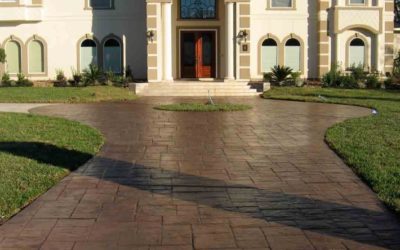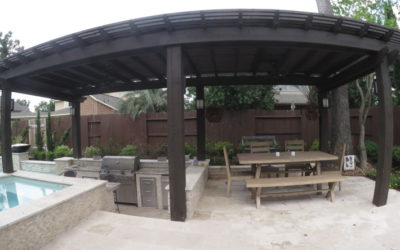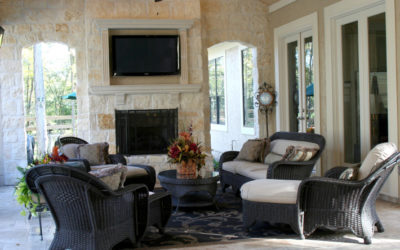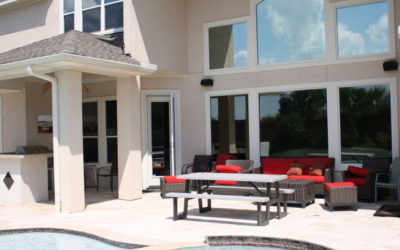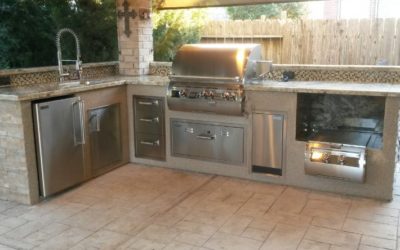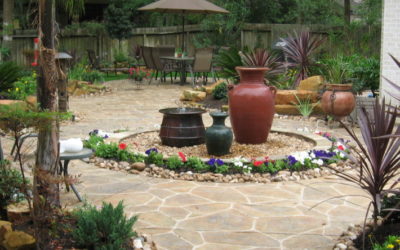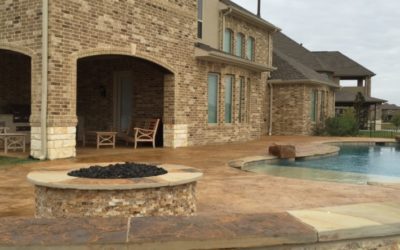
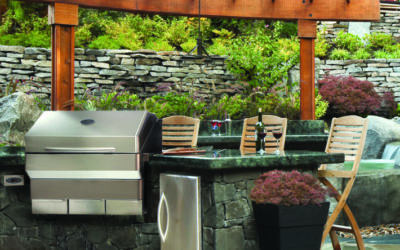
One of the most common designs in Outdoor Kitchens in the Katy, TX area, is as followed:
- 36" gas grill (can service at least 8 burgers, etc.)
- Storage under cabinets.
- Earth tone final finish on cabinets, stucco, ameristone, etc.
- Lights under bar area.
- Raised bar with lower bar to serve children.
- Back splash behind grill area.
- 12' to 15' cabinet size.
- Drawers (great place to put your bbq stuff and misc.)
- Power burner are nice but you have to watch where you put it, child can pull over pots and pans at that height.
- Almost always has a cover on top of kitchen, who wants to cook in the sun or rain.
- Sinks are nice for cleaning up, but it depends on how much it cost to tie into the sewer lines. Also French drains are a great way to get rid of grey water instead of tying into the sewer line.
1. Does the company warranty the work? If so, for how long? Yes, for one year
2. How come my concrete is cracked? Can you fix it for me so it will not crack? All concrete cracks, and all pavers will move with the ground conditions we have in the Gulf Coast region.
3. What is the difference between stained concrete and concrete that is dyed? With stain (water or acid) it can used outside, with dyes it really is for interior use.
4. What is the difference between a stamped overlay and stamped concrete? Overlay is 1/4" to 2 1/2" thick typical, while concrete would be 4" thick with rebar/fiber mesh.
5. How long will an overlay last before it begans to crack? First an overlay is only as good as the sub surface that it is applied on top of.
6. How long will stamped concrete last before it will crack? All concrete can crack the day of the pour, that is why rebar and or fiber mesh is to be used at all times.
7. One contractor told me I needed integral color for my slab, is that true? Integral concrete places the color thru out the concrete, which is nice if the concrete is chipped.
8. How many control joints should I have in my patio? Roughly every 10 to 12 feet.
9. Can you do anything to prevent my new driveway from being stained? You can always put a sealer on the driveway after the pour. It will help keep the driveway clean.
10. Can you tell me how to reseal my stamped concrete patio myself? Yes, and there are several videos on the web.
11. Does Increte of Houston do just stamped concrete? No, we do patio covers, outdoor kitchens, landscaping, ect.
12. How long should I wait before driving on my new driveway? I would wait for at least 3 days before driving on the driveway.
13. How come stamped concrete is so expensive? Compare to what, paver's no, regular concrete yes.
14. Why is your price so much more than the other contractor who bid my bid? Are they going to be in business in a year, insurance, warranty, all the bills paid or are you going to get an lien on your house.
15. I have an outdoor kitchen made out of wood. Can Increte of Houston repair it for me? No, we build all our kitchens out of steel or masonary.
16. Is your company listed with the Better Business Bureau? Yes, we are the 2010 & 2011 Winner of Excellence with the BBB.
17. Why do I need to have a sealant on stamped concrete but not on regular concrete? You can put a sealer on all concrete.
18. Should I keep my new driveway wet to help it cure? No
19. How come overlay and stamped concrete virually the same per square foot? The material is roughly the same cost.
20. Think Green, can the concrete that is being removed, be used on other project? Yes, we recycle all the concrete that we remove, none of it goes to a land fill.
The cost of an outdoor kitchen will depend largely on its size, the materials you select and the appliances you want installed. A basic outdoor cooking area with a patio, grill and counter top can run a few thousand dollars. While a luxury design with top-of-the-line appliances will cost many times that amount.
1. Cost of an outdoor kitchen built out of steel frame will run $350 - $500 per running foot.
2. Cost of an outdoor kitchen built out of brick or mason will run $385 - $550 per running foot.
3. Cost of an outdoor kitchen built out of wood. PRICELESS they can burn down your house.

The biggest ticket item in an outdoor kitchen is the grill. There are many manufacturers that offer grills at a variety of price points. Some drop-in grills are as affordable as nine hundred dollars, while others can cost more than ten thousand. Communicate clearly contractor how much you are willing to spend on the grill and what features you desire.
Pro Tip: Don't spend your whole budget on the grill. A luxury grill surrounded by sub-par counters looks out of place.
Pro Tip: If you are trying to keep the cost at a reasonable level forgo the sink, refrigerator and side burner. Instead locate the outdoor kitchen near your indoor one so that you can conveniently move between the two. You may even be able to use your kitchen window as a pass-through.
If money is no obstacle there are a variety of upgrades you can make to an outdoor kitchen. First, you can upgrade the materials. Instead of a stucco base, opt for a natural stone veneer. Instead of ceramic tile counters, opt for granite. Second you can upgrade the appliances. Brands such as Twin Eagles Grills and Fire Magic Grills offer premium outdoor grills and accessories. You may also want to consider including warming drawers, a deep fryer or other unique appliances. Third, you can add features that will turn your kitchen into entertaining central. Try an outdoor television with surround sound.
Pro Tip: Running utilities for an outdoor kitchen can be expensive. Try locating it near your home where water and electric are already available.
Pro Tip: Outdoor refrigeration appliances such as wine chillers and keg dispensers have ongoing costs to keep them cold and functioning properly. Another option is to install a beverage center that can be filled with ice to keep drinks cool during a party.
An outdoor kitchen is an excellent way to equip your backyard for entertaining and feeding hungry friends and family. Outdoor kitchens range from small areas with little more than a built-in barbecue grill to large, fully equipped kitchens complete with one or more grills, countertops, sinks, bars and storage cabinets.
When planning an outdoor kitchen, you'll need to think about how many people you intend to accommodate, your entertaining needs, and your budget. The next step is to determine the best location for your kitchen, the size requirements, design layout, countertop placement, and the appliances you'll need. Finally, you must choose the best materials and equipment for accomplishing all your goals.
Get these tips
In this section, you'll find tips from outdoor kitchen contractors on:
• The six most important factors to consider when deciding where in your yard to build an outdoor kitchen.
• The importance of creating zones in your outdoor kitchen for various functions, such as food preparation and cooking, dining, and socializing.
• Recommended dimensions for outdoor kitchen countertops, bar tops, dining tables and seat heights.
• Five common layouts for outdoor kitchens and the characteristics of each.
• The options for building the framework, or base, for outdoor kitchen structures, including concrete block, brick, wood or steel.
• The advantages of using prefabricated kits to build an outdoor kitchen.
• Advice on choosing paving materials for your outdoor kitchen "floor," including a comparison chart and cost overview.
• Ideas for economical and space-friendly built-in grills suitable for small outdoor kitchens.
• Design ideas for building a roofed structure over an outdoor cooking area to provide protection from sun and rain.
• A comparison of the various material options for outdoor kitchen countertops, including concrete, stainless steel, ceramic tile and stone.
• Resources for cabinets for outdoor kitchens that are weatherproof, heat resistant, and sealed to keep out dust and bugs.
• Tips for adding a swim-up bar to a swimming pool, along with recommendations for seat and counter heights.
• The various appliances and cooking equipment you'll need to create a fully functional outdoor kitchen, such as side burners, sear zones, griddles and warming drawers.
• The top three factors to consider when choosing free-standing grills for an outdoor kitchen.
• Tips for selecting a built-in stainless steel grill for an outdoor kitchen.
• Your options for decorative veneers to finish to the exterior walls of a built-in grill.
• Refrigerator styles for outdoor kitchens, including under-the-counter varieties with built-in drawers.
• Tips for maintaining the equipment and surfaces in your outdoor kitchen, including grills, stainless steel appliances and granite or stone countertops.
A fully equipped outdoor kitchen can be a big investment, but one that is sure to add lasting value to your home. To get help selecting the best equipment, materials and layout for your needs, be sure to consult with a professional.